We know that the brain has two hemispheres, the left hemisphere and the right hemisphere. We also know that both these hemispheres have the same four lobes. Yet, it has been proven that each hemisphere is better at certain functions. This tendency of the brain is known as lateralization.
Division of Functions
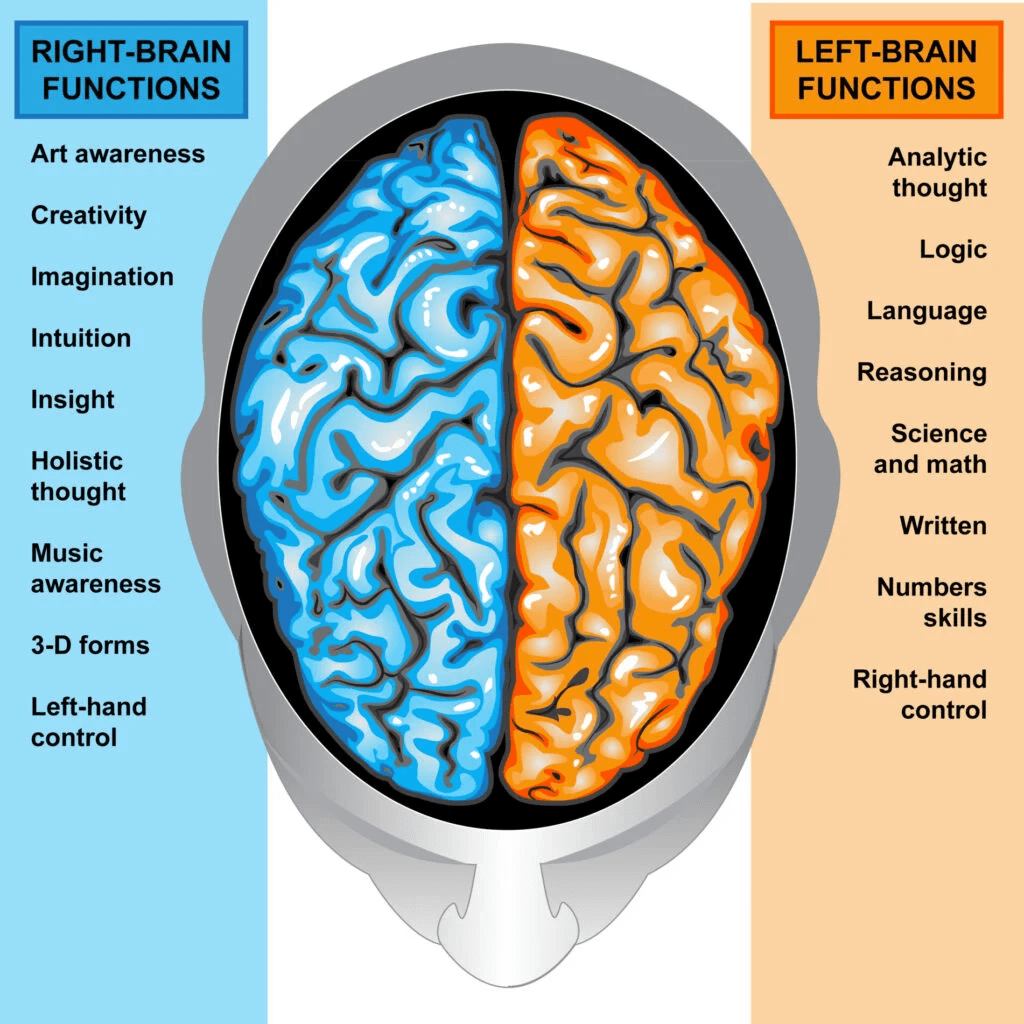
Though each hemisphere do share certain functions, each hemisphere also has a certain set of functions in which it is strong it. In general, the left hemisphere controls speech, comprehension, arithmetic, and writing while the right hemisphere controls creativity, spatial ability, artistic, and musical skills. Furthermore, the left hemisphere controls the movements of the right side of the body, and sees through the right eye. On the other hand, the right hemisphere controls the movements of the left side of the body and sees through the left eye. Confusing, right? But anyways, going back to lateralization, this distribution of functions causes certain interesting side effects.
Side effects of Lateralization
- Mothers exhibit a strong tendency to cradle their children with the left arm.
- 85-90% of the world’s population has a more developed left motor cortex
- Studies have proven that if a person is seated in a room, and they are asked to verbally identify what appears on the screen in front of them, they are very, very slightly slower when the image appears on the left side of the screen.
Now what is the relation between those 3 completely true facts? They are all caused by lateralization. Let’s break each one down, one by one.
- Though not much is known about this result of lateralization, mothers cradle children with their left arm more often due to a development of certain parts of their right hemisphere.
- This second fact is pretty simple. A developed left motor cortex indicates that the right side of the body is more specialized AKA, 85-90% of the population is right handed.
- The last fact basically said, we were able to verbally identify things slower when our left eye sees it. Why is this? When our left eye takes in photons, it sends those signals to the visual cortex in our right hemisphere. The signal then has to cross hemispheres to the left hemisphere as this is where speech happens. However, if we saw an image with our right eye, the left hemisphere would receive the information, so the information wouldn’t need to cross hemispheres to be expressed in words.
But speaking of crossing hemisphere’s, how does information cross each hemisphere?
Corpus Callosum
The transit of information from the left hemisphere to the right hemisphere is regulated by the Corpus Callosum. The corpus callosum isn’t anything but a bunch of nerve fibers, (which are just a bunch of axons). The corpus callosum contain over 300 million axons, and is the largest white matter structure in the brain. Without the corpus callosum, our brain is unable to communicate with itself, leading to a variety of speech problems, and physical and intellectual disabilities.
But when does one lose their corpus callosum? There is a common disorder, affecting roughly 1/4000 people, called corpus callosum agenesis. This developmental disorder causes the corpus callosum to be deformed or not even developed, which results in a multitude of problems. There is another situation when one loses their corpus callosum. In extremely severe cases of epilepsy, to prevent the seizure from spreading, surgeons will intentionally remove the corpus callosum, to isolate the seizure in one hemisphere of the brain.
So now, for the first time in this blog, I will ask you, the readers to respond to a quite tough prompt. When the corpus callosum is removed from an epilepsy patients’ brain, they are left with two brain hemispheres which are unable to communicate with one another. So, my question is, do you believe that the epilepsy patient is now in a split-personality disorder as they have two different voices in their head? Or not? And why?
 Behind the Brain
Leave a comment