The story of Phineas Gage is an unusual and saddening story, yet is quite informative, It reveals a lot about the connection between psychology and neuroscience, so let’s dive right in!
The Accident
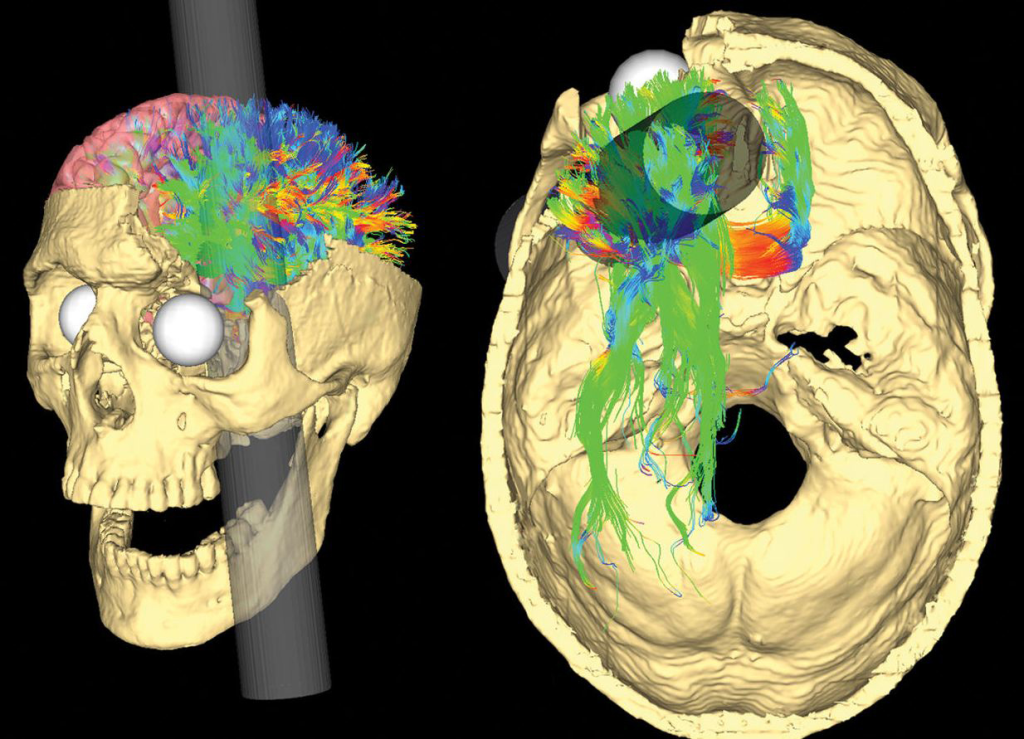
Phineas Gage was working as a railroad construction foreman for the Rutland & Burlington railroad. On September 13, 1848, while he was putting explosive powder into a hole, the powder was ignited by a spark, which caused a 3.5-foot-long iron pole to shoot upward through his left cheek, behind his left eye, pass through the top of his head, and land several feet away (depicted below).
Somehow, Phineas Gage was able to still walk with assistance after his accident, and after being treated by Dr. John Martyn Harlow, he had a quick physical recovery.
Effects
- Personality Changes: Although Phineas Gage had been a responsible, well-mannered person before his accident, afterward, he became socially inappropriate, impulsive and irritable.
- Emotional Instability: Phineas Gage experienced mood swings ranging from agitation and anger to euphoria and apathy.
- Cognitive Impairments: After the accident, Phineas Gage’s decision making, impulse control, and planning were impacted. Strangely though, his intelligence and memory were mostly unaffected.
These effects led to Phineas Gage losing his job, and wandering from job to job. He worked for some time in a traveling museum, as well as looking for jobs in San Francisco and Chile. Unfortunately, Phineas Gage passed away at the age of 36, due to seizures possibly related to his accident.
Neurological Functions Involved
Phineas Gage’s accident helped prove the localization of several neurological functions. For example, the frontal lobe, which was injured during Gage’s accident contains the dorsolateral prefrontal cortex, which is responsible for self regulation and decision-making. The frontal and temporal lobes also contain the ventromedial prefrontal cortex and amygdala respectively, which are used for regulating emotional responses.
Since Phineas Gage after the accident lost much control over his decision making, self regulation, and regulation of emotional responses, neuroscientists of late 1800s theorized that the frontal lobe controlled those functions. This led to the theory of localization (every function of the brain has a certain corresponding part of the brain), which has developed into the basis for modern neurology and neuroscience.
 Behind the Brain
Leave a comment