Note: The below article contains mention of suicide and abuse
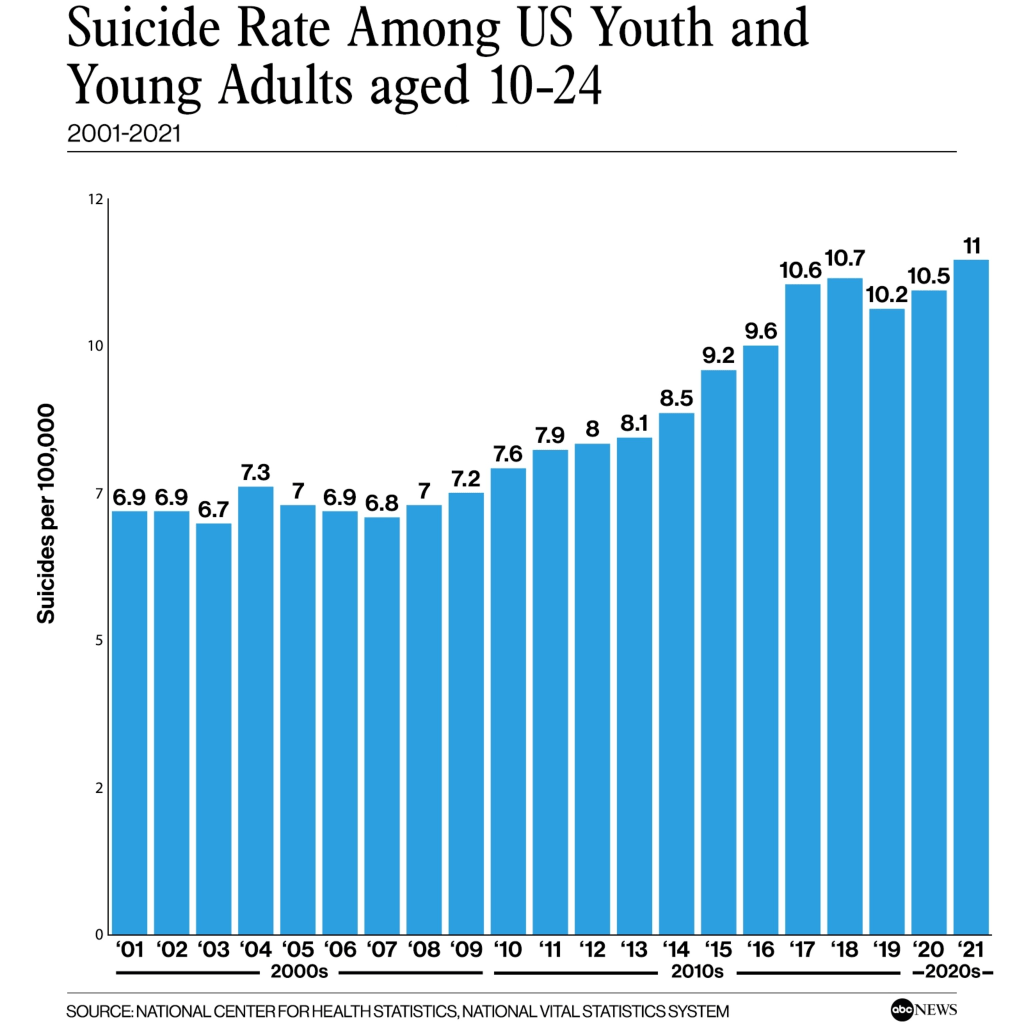
Everyday 132 people in the US commit suicide. Furthermore, this rate of suicide is only increasing, as depicted by the graph below. These suicides are often caused by mental health problems, bullying or stigmas, and emotional and physical pain and abuse. Unlike humans, animals only commit suicide as a sacrifice trying to save their children, or colony/pack. So why do humans commit suicide, and what role does early childhood adversity (ELA) play in suicide?
GABA’s Role in Suicide
Depression plays a major role in 66% of suicidal deaths. When examining the brains of depressed people who commit suicide, researchers in Canada found that they had fewer GABA (an inhibition neurotransmitter) receptors in their frontal cortex. Unfortunately, scientists are still unsure of why this deficit in GABA leads to depression/suicide.
What causes this lack of GABA receptors? Well the problem lies with the gene that encodes the GABA-A receptor (the specific GABA receptor that is missing). When examining the brains that were depressed and suicidal, the researchers found a methyl group (one carbon and three hydrogen atoms) attached to the GABA-A gene. This process, called methylation results inhibition of protein production, leading to less GABA-A receptors.
Let’s keep exploring deeper. Why does methylation happen to depressed people? Well the first thing to understand is that depression doesn’t cause methylation. In fact, a recent study showed that children who experienced abuse while growing up are more often to have methylation happen to them. Furthermore, since children who experience abuse are more likely to be depressed in their adulthood, we call the relationship between depression and methylation of the GABA-A gene, a correlation. Thus by comparing the methylation patterns of abused suicide victims vs not abused suicide victims, we can potentially identify how methylation leads to depression and late suicide.
HPA Axis During Suicide
The HPA axis’s response to stress shows another reason why children who were put through abuse during their childhood are more likely to commit suicide. Normally, when we are under stress, the HPA axis secretes corticotropin releasing hormone (CRH) and arginine vasopressin (AVP), which trigger the anterior pituitary gland to release adrenocorticotropic hormone (ACTH). ACTH then causes the adrenal cortex to produce cortisol, a hormone that acts like our stress alarm.
Once cortisol is produced, glucocorticoid receptors located in the hippocampus begin to slow down HPA activity thus preventing a panic or anxiety attack.
However, in individuals exposed to ELA, such as abuse or family economic hardship, the gene that encodes the glucocorticoid receptors are downregulated in the hippocampus. Thus, inhibition of CRH production is ineffective, leading to an extremely reactive HPA. This HPA starts to send out stress signals (cortisol) for everything, thus leading to anxiety traits, which can lead to suicide.
Conclusion
So as we’ve seen in this article, ELA is a huge risk factor for suicide, due to both environmental as well as neurological reasons. So if you know anyone who experienced ELA, I urge you to reach out to them every once in a while and just check in on them.
 Behind the Brain
Leave a comment