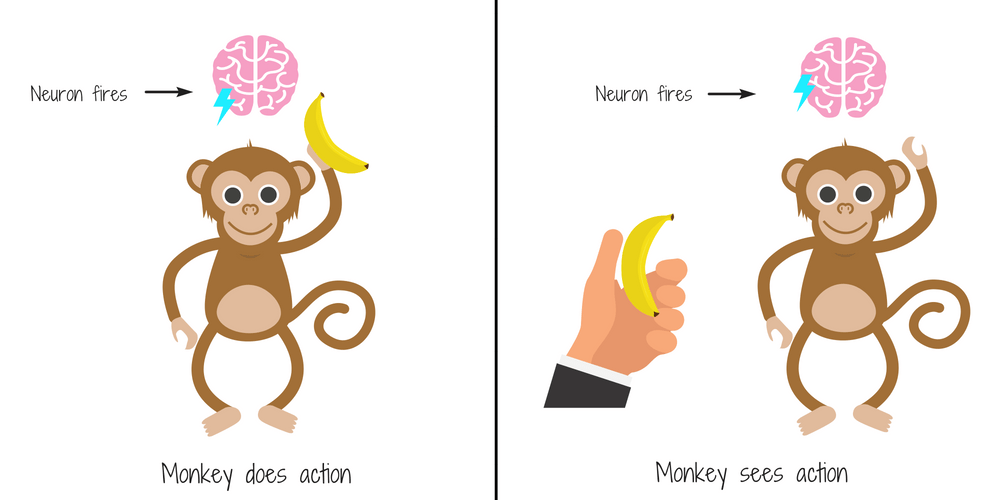
In the early 1990, Italian neuroscientists led by Giacomo Rizzolatti discovered mirror neurons. Mirror neurons are neurons that respond equally when we perform a certain action, and when we witness the same action being performed. This type of neuron explains why we feel excited as others are about to finish a race, or why we feel disgusted, when we see someone else recoil after eating a particularly disgusting food.
History of Mirror Neurons
Rizzolatti and his team initially discovered mirror neurons in macaque monkeys. Initially, this team of Italian neuroscientists was recording the activity of these monkeys’ motor cortex while the monkey’s were picking up different objects. While recording the activity of these monkeys’ motor cortex, they noticed something strange. Whenever the monkey picked up an object, its F5 neurons would fire. However, whenever the researchers picked up something to give to the monkeys, those same F5b neurons would fire. Thus they labelled these F5 neurons as mirror neurons.
Mirror Neurons In Humans
To discover mirror neurons in humans, scientists could not rely on direct measurements of neural activity. Since a macaque monkeys’ brain is smaller than a humans’, it is easier to record the activity of a single neuron. However, this is impossible when it comes to humans as humans have more neurons in their brain. Thus, placing electrodes to record a single neuron’s activity would be very dangerous.
To bypass this problem, the Ronald Reagan UCLA Medical Center conducted tests on epilepsy patients. Since these patients already had electrodes placed to identify potential surgical treatment foci, UCLA piggybacked off of that data to identify whether individual neurons were mirror neurons. The UCLA Medical Center was able to discover mirror neurons in humans as well as anti-mirror neurons (neurons that are excitatory when we perform an action and inhibitory when we see the action being performed).
Possible Functions
- Learning: Mirror neurons would activate while watching an action, and when doing the same action. Thus, they could form the same connections necessary for the action, simply by watching the action being performed
- Empathy: Mirror neurons have been theorized to help us with empathy. his is because mirror neurons literally, “put us in another’s position”
- Prediction of Action: Since mirror neurons activate when we act, and see, they help us predict what is about to happen next when we see an action being performed, based on what we do next when that action is performed.
- Human Self-Awareness: Perhaps the most intriguing theory regarding mirror neurons is the human self-awareness theory, presented by V.S. Ramachandran. According to Ramachandran, self-awareness AKA inner reflection, is caused by mirror neurons that activate, when you replay moments in your head, as if you are watching them unfold from a external perspective.
 Behind the Brain
Leave a comment