The title of this article is a question that has puzzled biologists and philosophers alike. What separates humans from the rest of animals? It’s true that we have higher intelligence, but so do dolphins, compared with sloths. Why don’t dolphins have their own classification? Do we separate humans from animals, solely due to our own ego?
Well, if you ask a neuroscientist what makes a human human, they may respond with the answer: ARHGAP11B. To elaborate, they might explain that ARHGAP11B is a gene only found in humans, and is responsible for the expansion of the neocortex – the part of the brain responsible for higher cognitive functions. ARHGAP11B aids in the expansion of the neocortex by creating more folds in the neocortex region of the brain. This allows more neurons to grow, thus forming more connections, while not taking up more space.
Evolution of ARHGAP11B Gene
About 5 million years, the ARHGAP11A gene was duplicated, and mutated to produce the “ancestor” ARHGAP11B gene. However, this mutated ARHGAP11B gene is the not the gene currently in humans. The “human specific” ARHGAP11B gene mutated independently from the same ARHGAP11A gene about 500,000 years ago.
Testing the Theory
Everything I’ve written above was a theory. That is until a study regarding this exact gene was published in June of 2020. In that study, neuroscientists inserted the “human specific” ARHGAP11B gene into marmosets, a creature very similar to humans in terms of neural organization. They did this by using a lentivirus – a carrier virus that can’t replicate. They also introduced a promoter gene – a gene that regulates the expression of another gene to ensure there wasn’t an over-expression of the introduced ARHGAP11B gene. Since marmosets have such smooth brains, any folding of the neocortex would immediately be visible.
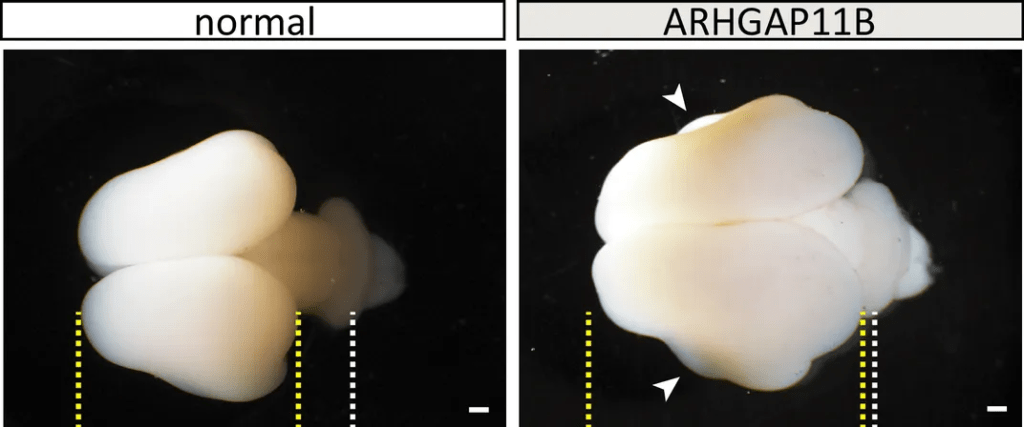
The results (shown above) however, not only proved these researchers’ predictions correct, but exceeded their expectations. Along with creating more folds and allowing more neuron-neuron synaptic connections, the introduced ARHGAP11B gene also controlled the production of neurons that develop later and are more important for higher-order processing.
 Behind the Brain
Leave a comment