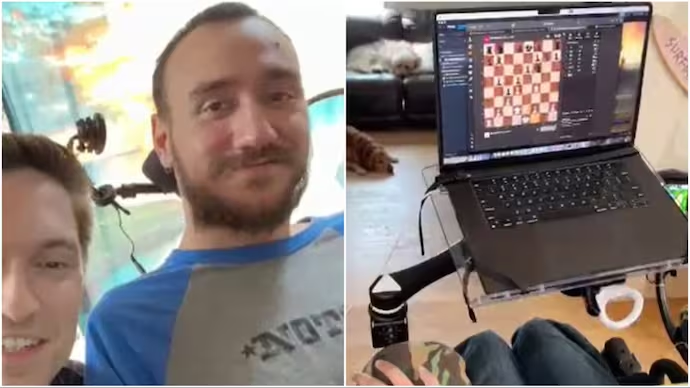
In 2016, Noland Arbaugh dislocated his C4 and C5 of his spinal cord in a freak diving accident, causing him to become paralyzed from the waist down. He wasn’t able to move his arms, legs, toes or fingers. Yet four days ago, on March 20th, Noland Arbaugh played chess online on chess.com, and played 8 hours of video games. So how was he able to control the computer? The answer lies in BCIs (brain-computer interfaces), but more specifically, the Telepathy BCI developed by Neuralink.
Neuralink
Neuralink, a startup founded by Elon Musk and based in Fremont, California, is currently focused on giving people with quadriplegia (paralysis of all four limbs), the ability to control their computers and mobile devices with their thoughts using a BCI. They do this by implanting a computer chip (called Telepathy) equipped with thin and flexible threads. These threads contain 1024 electrodes that record the activity of neurons, and can determine in real time whether a neuron has received or sent an electrical signal. Surgical robots developed by Neuralink weave these threads throughout the cerebral cortex. Once, the threads receive signals, they transfer the analog data back to main computer chip (Telepathy), where it is converted into binary. Once the data is in binary, Telepathy is able to control the computer thus allowing Noland to play chess.
History of BCIs
But this isn’t a new technology. In fact, the first working BCI was created in 1965, by American composer Alvin Lucier, where for the percussion to play, an EEG machine recording Alvin’s brain, had to detect alpha waves. In 1977, scientist Jacques Vidal created the first cursor controlling BCI, demonstrating that he could move a mouse through a maze using only his brain, and in 1988, a BCI that could control a robot’s movement was created. However, all three of these BCIs were non-invasive, meaning they could only record large signals of data. So although they couldn’t detect a single neuron firing, they could easily detect a fist clenching, or you getting angry.
Musk’s Neuralink is extremely invasive, requiring a permanent chip attached in your brain, as well as a robot to carry out the surgical procedure. However, due to the threads attached to the computer chip, Neuralink is able to detect individual neuron’s firing, making it easier for the user to interact with the computer.
Future Plans
Elon Musk’s next focus is a computer chip that would cure blindness. Called Blindsight, this computer chip would take input from external cameras, and would stimulate the visual cortex based on camera data, thus “tricking” the brain into seeing what the cameras see.
Ethical Concerns
Several scientists are raising concerns about the ethics of BCIs, bringing to light Musk’s end goal of equipping the public with brain implants that enhance our cognitive abilities and help humans keep up with AI. However, it is safe to say that for now, from helping paralytics play chess, to potentially helping the blind see, BCIs are only doing good.
 Behind the Brain
Leave a comment