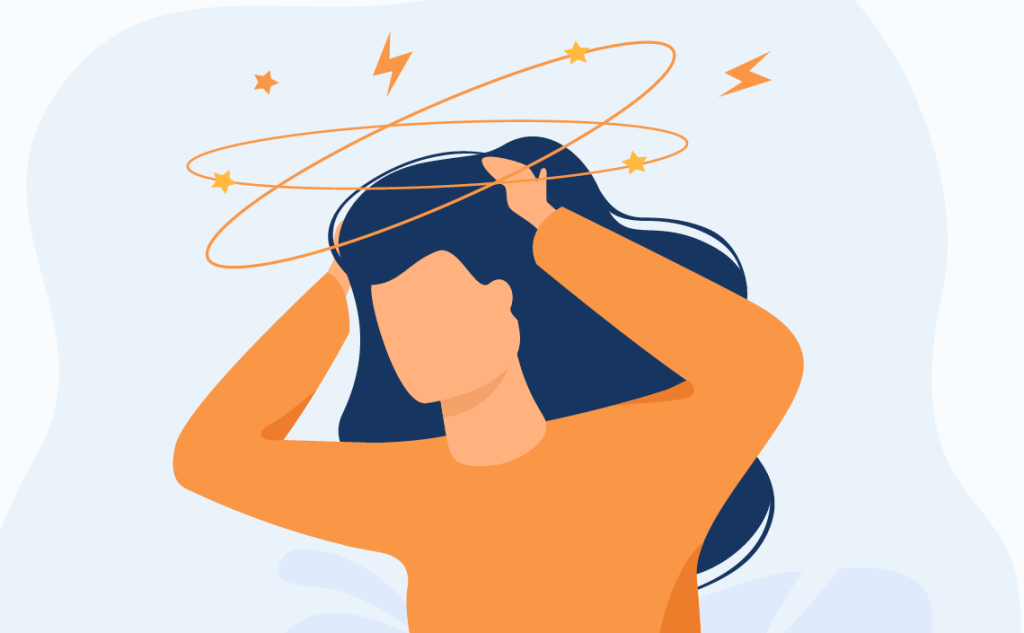
Spin around five times. Then do that ten more times. Now stop. Do you still feel like you’re spinning? This is called dizziness, and we all have felt it, from spinning around like you just did, to going on merry-go-rounds. But what causes dizziness?
How does the brain orient our body?
When you are upside down, even with your eyes closed, you know that you are upside down. If you’re turning in a car, and you can’t see outside, you’ll still be able to tell which way you are turning. How does this work? Well you can thank your ears for this ability. Inside our ear canals, we have a liquid fluid called endolymph. Our ear canals also contain little hairs suspended in the cupula (a gelatinous structure in the ear canal). When the endolymph moves, it also moves the hairs in the cupula, kind of like how kelp moves due to ocean currents.
When we turn our head/ body, the inertia of the endolymph causes it to push the hair cells in the cupula. If these hair cells are deflected one way, they will be inhibited, if pushed the other way, they will be excitatory. To be more specific, whichever way your head turns, that ear’s hair cells will be excited. Therefore, whenever one ear’s hair cells are excitatory, the other ear’s hair cells must be inhibitory. This whole system is referred to as the vestibular system (system that helps with orientation and balance).
These excitatory and inhibitory signals are transmitted to the vestibular nuclei of the medulla of the brain stem. Within the vestibular nuclei, neurons carry the vestibular information (information about orientation and balance), to the cerebellum, spinal cord, pons, and other areas of the medulla. Thus the brain is able to decode the vestibular information and figure out our body’s orientation in space.
Effects of the Vestibular System
- Dizziness: Coming back to the original topic of this post, dizziness, when we spin around in circles, the endolymph in our canals continue to swirl around, kind of like a toilet seat. This causes our brains to think that we are still turning, thus causing dizziness.
- Seasickness/Carsickness: Since when on a car or boat, we are constantly moving, the endolymph in our canals are always moving. However, since when traveling in a car, we are technically in the same frame of reference as the car, our endolymph doesn’t move unless the car suddenly accelerates or brakes. This is why seasickness is much more prominent, and causes much more nausea.
- Vertigo: Vertigo is an extreme version of dizziness that happens when both canals give off excitatory signals. In extreme cases, vertigo is dealt with by cutting one vestibular nerve, such that the brain doesn’t have to deal with conflicting inputs.
 Behind the Brain
Leave a comment