In order to complete complex tasks more efficiently, neurons send coordinated electrical signals. These coordinated signals often result in brain waves. Brains waves are measured based on their frequency. Each brain wave have certain functions that they are associated with.
Types of Brain Waves:
Delta Waves (0.5 – 4 Hz):
Delta waves have the lowest frequency among all brain waves. They occur during deep sleep and are responsible for restorative sleep and bodily rejuvenations. Delta waves also occur during anesthesia, generalized epileptic seizures, and disorders of consciousness, such as comas and the vegetative state. Delta waves originate in the thalamus which then decreases our reception of motor and sensory information about our surroundings, thus decreasing our awareness of the physical world and cause us to feel drowsy. Therefore, we decrease delta waves when trying to focus. On the other hand, individuals with ADHD naturally increase their Delta waves while trying to focus, which prohibits their ability to focus and be attentive.
Theta Waves (4 – 8 Hz):
Theta waves reflect the subconscious mind, situated between wakefulness and sleep. Thus these waves are present during light sleep and deep relaxation. Theta waves also have a correlation with daydreaming, intuition, and creativity. Although abnormal in awake adults, it is normal in children up to the age of 13. Similar to delta Waves, Theta waves counteract the ability to concentrate and focus
Alpha Waves (8 – 12 Hz):
Alpha waves are the balancing point between alert and asleep. Though they help to mentally coordinate, alpha waves help to relax and feel at ease. Alpha waves also are the most common wave present in the human brain after the age of thirteen. Alpha waves are present when a person is alert without action. This alertness comes from the fact that alpha waves originate from electrical signals sent from the thalamus, the part of the brain responsible for all incoming motor and sensory information apart from smell.
Beta Waves (12 – 30 Hz):
Beta waves are produced during periods of high alertness and agitation. They come during analytical problem solving, decision making, and processing information. People with ADHD are unable to produce this brain wave when focusing and instead produce delta and theta brain waves, as discussed above. Since the beta brain wave has such a large range, it is split into three categories.
Low Beta Waves (12 – 15 Hz):
Results in relaxed but focused mindset
Mid-Range Beta Waves (15 -18 Hz):
Results in self-awareness; Alertness without agitation
High Beta Waves (18 – 30 Hz):
Results in high mental activity such as math, or planning. This brain wave frequency is the most common during waking hours. Results in agitation and alertness.
Gamma Brain Waves (> 30 Hz):
Gamma waves are the only brain wave that have been found in every part of the brain. This is because gamma waves are responsible high-level processing, which only occurs through connections between different parts of the brain. Thus, a lack in production of gamma brain waves can result in learning disabilities.
Ripples (80 – 140 Hz):
Ripple waves are extremely high frequency waves that last for less than 150 milliseconds. They play a crucial role in memory consolidation, especially during sleep.
Electroencephalography:
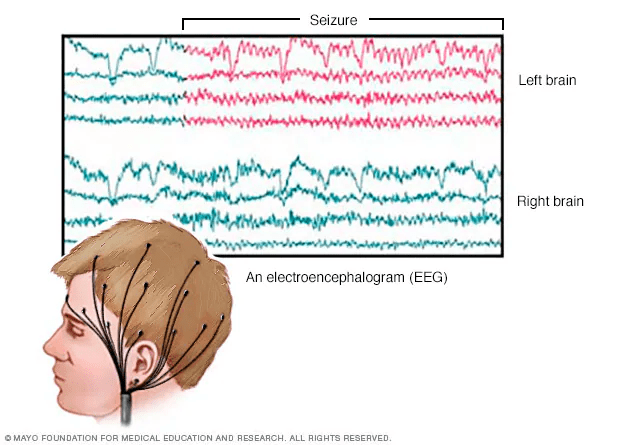
But how do scientists detect these brain waves? In order to detect brain waves, scientists use EEG (electroencephalography; shown below), to amplify and record detected brain waves.
Steps of EEG:
1. Electrodes
Electrodes are small metal discs that are attached to the scalp at specific locations. Once many neurons synchronize their electrical signals, these electrodes detect these electrical signals.
2. Recording
The electrodes send these electrical signals to an EEG machine which records the data as a series of waves. The brain waves are categorized into the different types of brain waves.
3. Applications
Any abnormality in the data can be used to detect neurological disorders such as epilepsy, ADHD, and sleep disorders. Even without abnormalities, the data is used to better scientists’ understanding of cognition, brain function, and impacts of stimuli on the brain.
Strengths and Weaknesses of EEG
EEG has high temporal resolution, which means it detect changes in brain activity with millisecond precision. This is especially useful for detecting brain waves such as ripples. However other neuroimaging techniques like fMRI have much higher spatial resolution. Thus, EEG is often used in combination with other methods.

 Behind the Brain
Leave a reply to The Sleep Cycle – Behind the Brain Cancel reply