I was playing chess on lichess.org and just scrolling around on their blog page, when I saw a blog that caught my eye. Reading it made so many neuroscience related connections for me, that I spent most of the last 3 days researching this one topic. Let’s dive.
Chess is a highly mentally stimulating game. But something most people don’t know about chess is that at the highest levels of chess, GMs (grandmasters) prepare openings with the use of computers. they memorize the best moves up to 20 moves in advance. Hence, during the opening phase of a game, the creativity and decision making of a GM isn’t tested, but rather their memorization. An article I saw recently, (Article Linked Here) talked about a new method to opening preparation. Rather than memorizing the best moves, by deviating slightly from the best moves and memorizing that pathway/branch of moves, you could take their opponent away from their memorization (assuming your opponent assumed you would play the best moves), while staying in your own preparation. However, this strategy would incur losses due to the fact that intrinsically, your position would be worse, although you would know the position much better. So here comes the interesting part. I reached out to the author of this article NDPatzer (an anonymous neuroscience professor in Canada) and asked him whether this strategy of preparation would have any brain related applications. In his response, he mentioned crystallized intelligence vs. fluid intelligence. In a nutshell, crystallized intelligence is based off of memorization, while fluid intelligence is based off of logic, reasoning, and decision making.
Dementia & Crystallized VS Fluid Intelligence
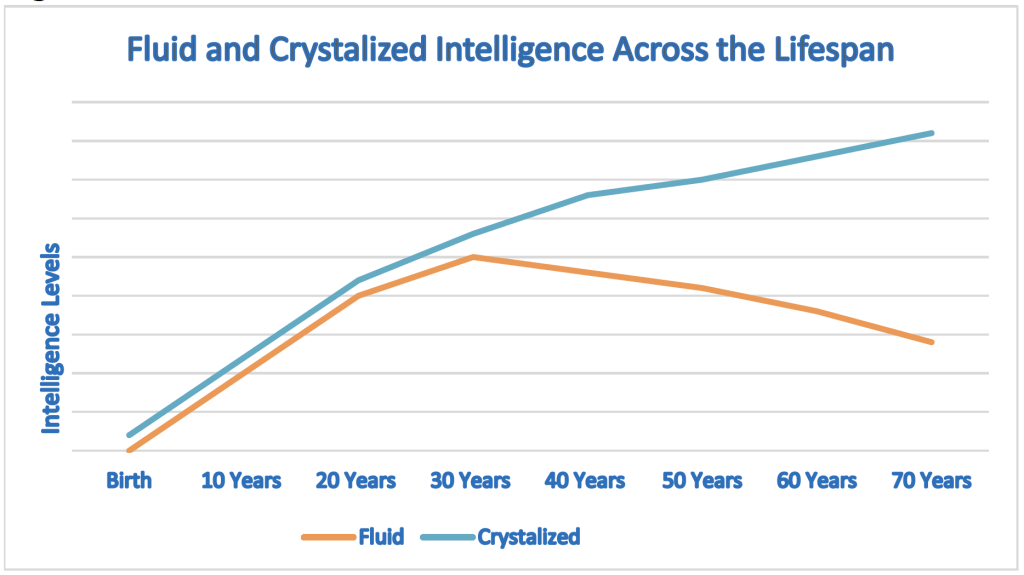
Now does fluid intelligence sound better than crystallized? Yes. But its not. Studies have consistently proven that these two are equally valuable. So what roles do they play? Let’s look at the data. Fluid intelligence and crystallized intelligence both begin to increase throughout your early childhood and teens. However, at around 30-50 years of age, fluid intelligence begins to decrease, continuing to decrease throughout old age. On the other hand, crystallized intelligence continues to increase into old age, although the rate at which it increases, decreases (as shown below). We also know that the risk of getting dementia increases as you age. But dementia is loss of memory; crystallized intelligence is remembering of information. So how can both be increasing at the same time? This is where the rabbit hole spirals.

Firstly, crystallized intelligence tests are favored towards older people. Often, these tests are verbal and will have you draw on past experiences, so the more experiences you have, the better you will do. Secondly, as we age, we learn more general knowledge, hence our crystallized intelligence is greater.
Lastly, memory actually gets stronger with fluid intelligence. Most of our memory is organized via associative paths, based on principles of contiguity. In other words, “things we remember” are connected based on their relation to each other. This is how we can remember the tune of a song after being reminded the first two notes of the song. Associative paths are based off of logic, so an increase in fluid intelligence would strengthen these associative paths. In conclusion, since fluid intelligence decreases with age, the strength of our associative paths decreases. This increases our risk for neurodegenerative diseases such as dementia.

 Behind the Brain
Leave a reply to Anonymous Cancel reply