Several comparisons have been made between our brains and computers. On a basic level, our neurons are either excitatory or inhibitory, similar to a computer bit being 1 or 0. Our brains are also capable of computing, and manage different functions all at the same time. Similarly, a computer has to process several functions at the same time. Lastly, our brain takes in inputs from different parts of the body, and translates those into other outputs. Likewise, a computer takes in user input.
However, regardless of all these similarities, our brains are vastly more complex and efficient than computers. For example, the world’s strongest supercomputer, Frontier, matches our brains in terms of computing power, but uses a million times for energy.
There is a theory however that relates our brains and quantum computers. Although quantum computers haven’t been created yet, theoretically they would be millions of times more powerful than today’s supercomputers. So how does this theory work? Let’s dive in!
Quantum Computers
Before relating quantum computers and brains, we need to establish what a quantum computer is. A regular computer runs on bits, which occupy either a state of 1, or 0. Combinations of these bits make up numbers, and allow for calculations. In a quantum computer, qubits would be able to occupy both states of 1, and 0 in a quantum phenomenon known as superposition. This would allow qubits to exponentially increase storage data, as compared to regular bits, thus making quantum computers faster at calculating.
Superposition & Consciousness
Neurons have long cylindrical structures called microtubules. These are extremely small and are often found in axons (the part of the neuron that sends messages) and dendrites (the part of the neuron that receives messages), and they can determine the shape of of these axons and dendrites. There has been research that proposes that these microtubules stay in a state of superposition, until they reach a certain quantum energy level. At this stage, microtubules collapse from a quantum state (superposition) to a state that more resembles classical physics (what we consider normal physics). This collapse is called called “Orchestrated Objective Reduction” (Orch OR). When Orch OR happens, the microtubule is binded to a certain moment in space and time. Theoretically, this happens all the time to all of our microtubules, hence connecting all those moments in space and time, thus creating what we perceive as consciousness.
Quantum Entanglement & Consciousness
However, as recent as August 2024, a new quantum phenomenon was proposed as the cause of consciousness: Quantum Entanglement.
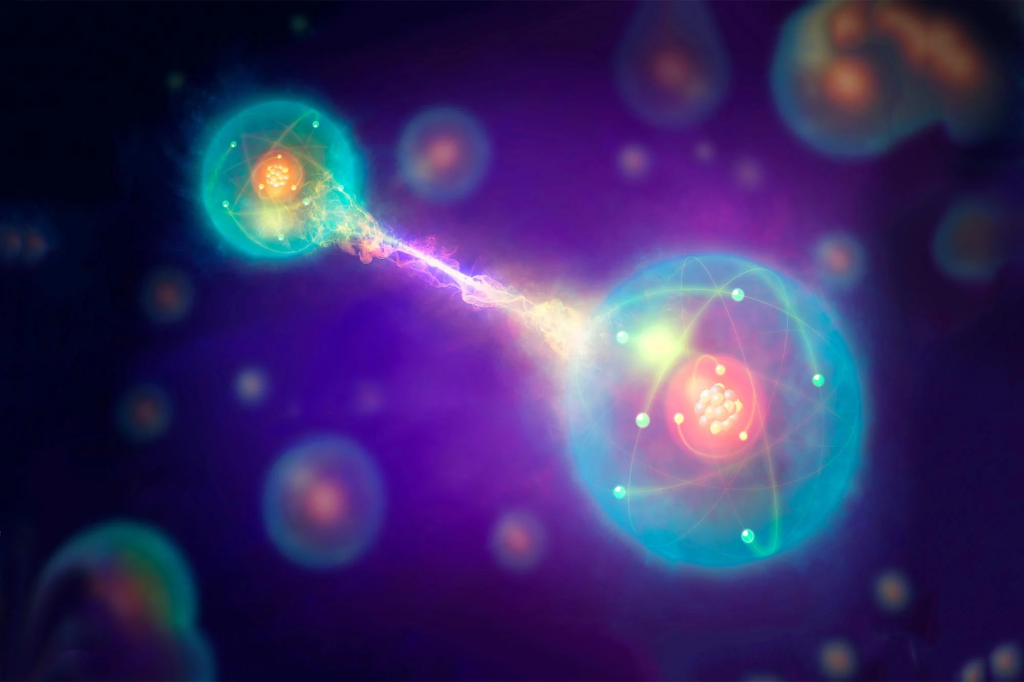
Quantum entanglement is when two particles are connected no matter the distance between these particles. This connection will ensure that properties of one particle will always depend on properties of the other particle. We can see quantum entanglement in action when observing a pair of electrons. A natural pair of electrons found in atoms will always have an electron that has a down spin, and one electron that has an up spin. Even when separated by kilometers, when scientists forcibly reversed the spin of one electron, the other electron’s spin naturally reversed as well, thus showing their quantum entanglement.
Now back to the brain. This month, a study was published that showed that myelin (a fatty substance that surrounds a neuron’s axon) had ideal conditions to entangle a pair of photons. If these pairs were entangled in mass quantity, they could potentially allow for a quantum communication system, synchronizing the whole nervous system.
Complications
While it seems cool to think that all these quantum processes could be happening in our brain, it is likely that our brain is rooted in classical physics. Most neuroscientists don’t believe that our brain has quantum processes occurring. Firstly, to create these quantum phenomenon in a lab, you need a extremely low temperature, without any extra particles. This is quite opposite from our wet, hot, messy brain. Furthermore, to prove quantum processes occurring in our brain in near impossible.
In conclusion, although quantum processes may be occurring in our brain, most of our brain is rooted in classical physics, and proving the existence of these processes will require more research.

 Behind the Brain
Leave a reply to soggejemiah1989 Cancel reply