Neurons are the remarkable communication specialists of our nervous system, capable of transmitting information across vast networks with incredible speed and precision. At the heart of this communication lies the axon terminal, a sophisticated structure that plays a crucial role in how our nervous system operates.
Basic Review of a Neuron
Before diving into the axon terminal’s function, let’s review the neuron’s basic anatomy. Remember, the neuron is a complex messenger cell, but for our purposes, it can be simplified to three parts: a cell body (soma) serving as its control center, dendrites as receivers for incoming signals, and the axon acting as transmitters.
The Resting Potential
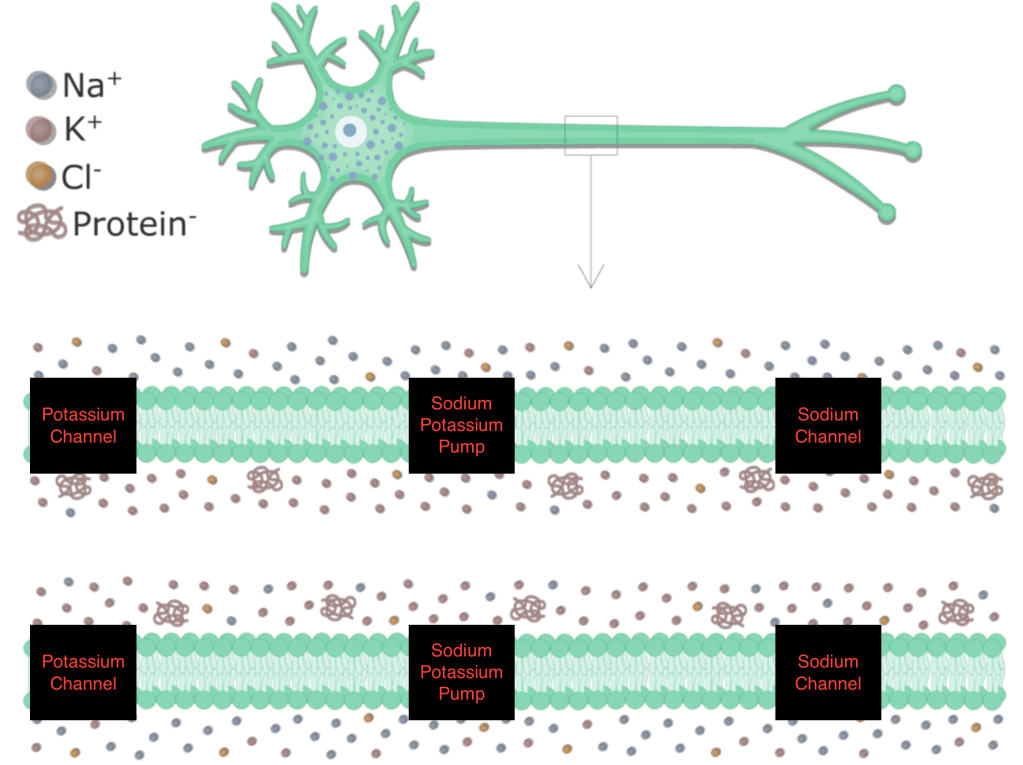
In order to understand how an axon transmits electrical signals, we need to understand the concept of potentials. Notice in the diagram below how there is more Na+ (Sodium) outside the axon than inside. Conversely, there is more K+ (Potassium) inside the axon than outside. This happens due to the sodium potassium pump (Na+/K+ Pump), which pushes 3 Na+ atoms out of the axon, and takes in 2 K+ atoms. Every time this process happens, since more Na+ is going out than K+ coming in, the inside of the cell becomes more negatively charged than outside. This difference in charge is referred to as potential.

When at a resting potential (-70 millivolts or mV), only the Sodium Potassium Pump is open. The Sodium Channel and the Potassium Channels are both closed. When triggered by a stimulus, such as the action potential of another neuron, the potential rises from the resting potential to the threshold potential (-55mV). If the axon doesn’t reach the threshold potential, the axon doesn’t fire or signal anything. If the axon does reach the threshold potential, the next phase of axon signaling occurs.
Depolarization
Once the axon reaches the threshold potential, the sodium channels open rapidly. Looking at the diagram below, we can see that the sodium flows from regions of high concentration to regions of low concentration. Hence sodium flows into the axon. Since sodium is charged positively, this increases the inside charge of the axon, thus increasing the potential of the axon to about +40 mV.

Once one section of the axon is depolarized, it also increases the surrounding areas of the axons’ potentials. This triggers depolarization in those areas, thus creating a domino chainof depolarization.
Repolarization
Once the potential of the axon rises too much, the sodium channels quickly close, and potassium channels open. Potassium also flows from high concentration to low concentration; Hence, potassium flows out of the axon. Since potassium is also positively charged, the potential of the axon decreases. In fact, in a process known as hyperpolarization, for a brief moment, the membrane potential actually becomes more negative than the resting potential. This brief “undershoot” ensures that the neuron cannot immediately fire another signal, preventing continuous firing and allowing for precise signal control.

The Axon Terminal’s Grand Performance
Once the action potential reaches the axon terminal, rather than continuing to transmit electrical signals, the axon swithces to chemical messengers (neurotransmitters) . Upon recieving the electrical signal of the action potential, calcium channels at the axon terminal open, allowing calcium ions to rush in, which causes tiny vesicles (tiny membrane sacs that store and transport things, in this case, neurotransmitters) to fuse with the cell membrane and release neurotransmitters into the synaptic cleft—the tiny space between neurons.
These neurotransmitters then bind to receptor sites on the receiving neuron, thus completing the axon’s job of transmitting the message.
The Precision of Neuronal Communication
What makes this process extraordinary is its speed and accuracy. The entire action potential occurs in just a few milliseconds, allowing for near-instantaneous communication across our nervous system. Whether it’s helping you withdraw your hand from a hot surface or allowing you to read these words, neurons are constantly performing this intricate dance.
Understanding the axon terminal and action potential reveals the breathtaking complexity of our nervous system—a network of billions of neurons communicating with millisecond precision, enabling everything from our simplest reflexes to our most complex thoughts.

 Behind the Brain
Leave a reply to Multiple Sclerosis: How the Brain Fights Itself – Behind the Brain Cancel reply